
 DoseCraft
 VapeHeatLab
Sant Jordi in Barcelona: The Day of Books and Roses
April 23 is Sant Jordi in Catalonia, the day Barcelona becomes an open-air bookstore and flower market. The story behind the tradition, how it eventually landed on the anniversary of Shakespeare and Cervantes, and the aromatic compound roses quietly share with cannabis.
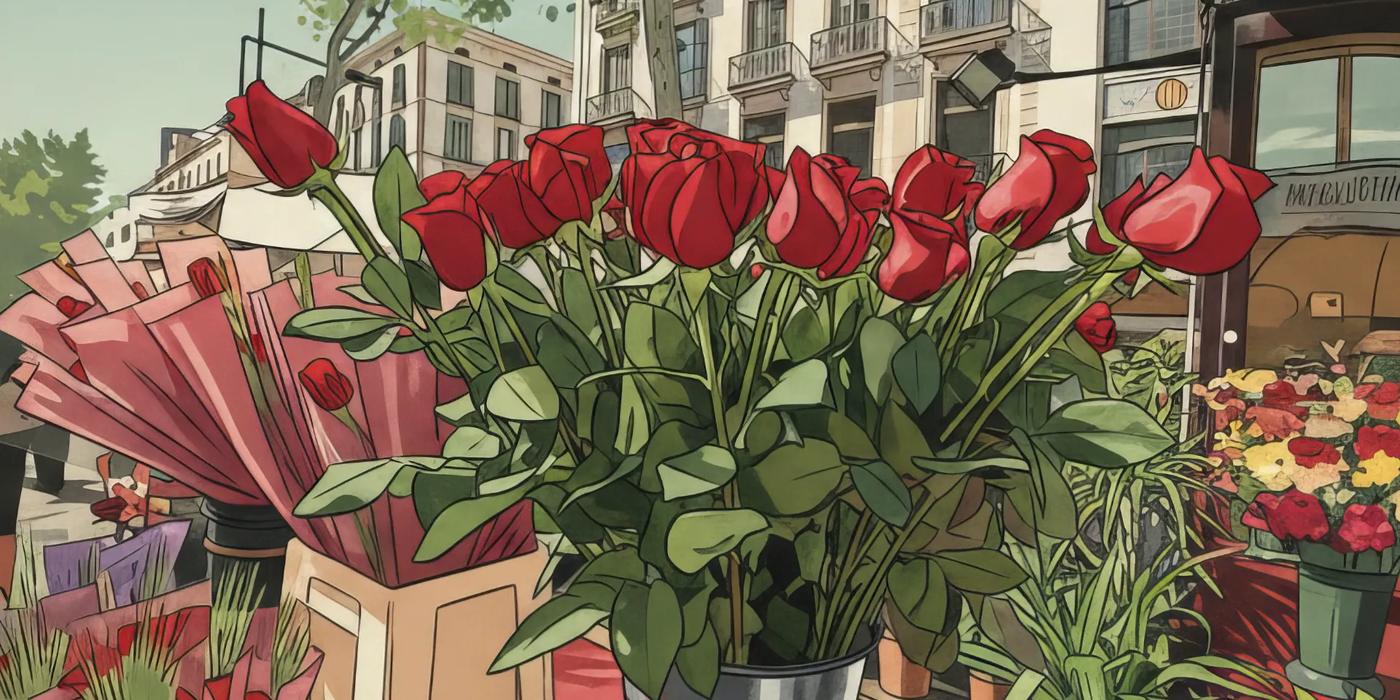
If you were in Barcelona yesterday, you walked through a city that briefly became a giant open-air bookstore. Every major street turned into a double row of stalls, half selling roses, half selling books. Shop fronts were draped in the red and yellow stripes of the Catalan flag. Couples held hands in the crowds. Authors sat at folding tables signing their latest novels. By the end of the day, Catalonia will have sold several million roses and well over a million books, most of it in the span of a single afternoon.
This is Sant Jordi, and if you live outside Catalonia it is probably the most beautiful cultural holiday you have never heard of.
The legend underneath the holiday
Sant Jordi is the Catalan name for Saint George, the patron saint of Catalonia. The legend is the one you half-remember from childhood: a dragon terrorizing a town, a princess about to be sacrificed, a knight in armor who shows up, slays the beast, and saves her. The Catalan version adds a specific detail. When Saint George cut down the dragon, a rose bush grew from the spot where its blood spilled, and he handed a single red rose to the princess.
For centuries after, Catalan men gave Catalan women a red rose on April 23 to mark the legend. The rose was often paired with a small ear of wheat for fertility, wrapped together with a strip of the Catalan flag.
How books got involved
The book half of Sant Jordi is much more recent, and the story behind it is worth knowing.
In 1923, a Valencian writer and editor named Vicente Clavel, who directed the Cervantes publishing house in Barcelona, proposed creating a national Day of the Book in Spain. The idea languished for a few years. In February 1926, the Catalan Chamber of Books formally adopted his proposal and declared October 7 as the official Book Day.
Nobody much liked October 7. In 1931, Catalan booksellers requested the date be moved to April 23 to align with the anniversaries of the deaths of Miguel de Cervantes and William Shakespeare, both of whom died in 1616. The move also meant Book Day landed on the same date as the ancient rose fair of Sant Jordi. The two traditions merged on their own, helped along by the coincidence of books and flowers being the two most obvious things to sell from a sidewalk stall in April.
That merger is why April 23 today is both a deeply local Catalan holiday and, since UNESCO adopted it in 1995, the official World Book Day.
La Rambla, the epicenter
If you want to see Sant Jordi at full volume, La Rambla is where you go. Barcelona's central pedestrian boulevard becomes a continuous procession of pop-up book tables and flower vendors, with the Liceu opera house at one end and the Christopher Columbus monument at the other. Some of the roses are bundled in red foil. Others are wrapped in pink tissue paper and tied with the Catalan flag ribbon. The whole street smells like rose and old paper.
Smaller neighborhoods run their own versions. Plaça Sant Jaume, outside the Generalitat, hosts official ceremonies. Bookstores in Gràcia and the Raval stay open late. Every bar runs a Sant Jordi menu. It is the closest Barcelona gets to a true citywide ritual.
The terpene connection
Because this is Herbistry, a quick aromatic aside. The dominant compound that gives a fresh rose its characteristic scent is a terpene called geraniol. Geraniol also appears in cannabis, typically as a minor terpene but present in most strains. It is part of why some cannabis flowers smell vaguely floral underneath the fuel or fruit character, and it is one of the compounds that carries over into rose water, rose oil, and classical perfume bases. So if you happened to spend Sant Jordi carrying a bouquet through La Rambla and later noticed the same floral edge in an evening session with friends, the overlap is not in your head. It is the same molecule, in different plants.
A city with more than one signature tradition
Barcelona is also globally recognized for another cultural export, its network of private cannabis associations, which have shaped how people think about cannabis culture in Europe for the last decade. The two things are not usually discussed in the same paragraph, and yet both are genuine expressions of what makes the city particular. Barcelona is a place where a medieval religious tradition and a modern social one can coexist without conflict, each celebrated in its own spaces.
If you missed Sant Jordi this year, the date comes back around. April 23, every year. A book, a rose, and enough roses sold in a single afternoon to fill every bathtub in a small country.
Frequently Asked Questions
When is Sant Jordi celebrated in Barcelona?
Why do people exchange books and roses on Sant Jordi?
What is the legend of Sant Jordi?
Where is the best place to experience Sant Jordi in Barcelona?
References
- Wikipedia. Saint George's Day in Catalonia
- Casa Batlló. Saint George's Day — Legend, roses and books
From the Shop
See all



Related Posts
 Lifestyle
What Living in Spain Taught Me About Slowing Down
Moving to Spain rewired how I work, eat, and sesh. Long lunches, the evening paseo, dinner at hours LA would call irresponsible, and a rhythm that treats rest as scheduled instead of earned. Here is what it changed for me, and the pieces you can steal without a plane ticket.
 Lifestyle
How to Clean Ed's TNT Wooden Bowls (Without Ruining the Wood)
Wooden bowls do not clean like glass, and treating them the same is how good wood dies. Here is the wood-safe routine I use on my Ed's TNT pieces: a dry brush, a careful iso swab, zero soaking, and a full dry before the next session. Plus the two-minute conditioning trick straight from Ed himself.
 Lifestyle
How to Clean and Maintain Your Dab Rig
A clean rig means better flavour, smoother hits, and a longer life for your glass. Here is a practical guide to keeping your rig and banger spotless without overcomplicating it.